How Much Is Your Los Angeles Home Really Worth in Today's Market?
How Much Is Your Los Angeles Home Really Worth in Today's Market? If you've ever typed your address into an online home value estimator and watched...

How Much Is Your Los Angeles Home Really Worth in Today's Market?
If you've ever typed your address into an online home value estimator and watched a number pop up in seconds, you already know how satisfying — and how misleading — that can feel. The number looks official. It has decimal points. It must be right.
Except it often isn't.
I work with homeowners across Los Angeles County, Orange County, the Inland Empire, and Ventura County, and one of the most common conversations I have starts with someone saying, "Zillow says my home is worth X — is that accurate?" Sometimes it's in the ballpark. Sometimes it's off by tens of thousands of dollars in either direction. And when you're making one of the biggest financial decisions of your life, "in the ballpark" isn't good enough.
So let me walk you through what actually determines what your Los Angeles home is worth right now — and why that number is probably more nuanced than any algorithm can calculate.
Why Online Estimates Fall Short in LA
Los Angeles is not one market. It's dozens of micro-markets stitched together — and they behave very differently from each other.
A home in Pasadena near the Arroyo does not move like a home in Boyle Heights. A property in Arcadia's school district doesn't behave like a comparable square footage in El Monte. Silver Lake's market has its own personality entirely compared to neighboring Echo Park. And in areas like Montebello or Monterey Park, a single block can sometimes separate two very different buyer pools.
Online estimators are built on broad datasets. They look at recent sales, tax records, and general trends — but they can't see:
- Whether your kitchen was recently updated or still has 1980s tile
- That your backyard is a private, landscaped retreat vs. a concrete slab
- That your street backs up to a noisy commercial corridor
- That your neighborhood just had a new school rating update
- That there are only two comparable homes in your zip code that sold in the last 90 days
These details matter enormously in pricing strategy. They're things I walk through in person when I'm inside your home — not things a database can replicate.
What a Comparative Market Analysis Actually Does
When I prepare a Comparative Market Analysis (CMA) for a seller, I'm doing something fundamentally different from what an automated tool does.
A CMA looks at what buyers have actually paid for homes similar to yours — recently, in your specific area, under current market conditions. But it's not just pulling numbers. It requires interpretation.
Here's what goes into a real CMA:
- Sold comparables ("comps"): Homes similar in size, bedroom/bath count, lot size, and condition that have closed escrow recently — typically within the last 90 days, sometimes less in a fast-moving market
- Active listings: What's currently competing with your home for the same buyer pool
- Pending sales: What buyers are agreeing to pay right now, even before those deals close
- Days on market: How quickly or slowly similar homes are moving — which tells us whether buyers have leverage or sellers do
- Price reductions: If nearby listings have had to drop their price, that's important context
- Condition and upgrades: A home with a remodeled kitchen, updated bathrooms, or a newer roof commands more than one that hasn't been touched in 15 years
I also factor in the story behind the numbers. If a home sold unusually fast or unusually slow, there's usually a reason — and understanding that reason helps me price your home more strategically.
The Conditions That Are Shaping Values Right Now
I won't pretend the Los Angeles market is simple to read at the moment. Inventory has been shifting. Interest rates have continued to influence buyer behavior. And different price points are performing very differently.
In general, well-priced, well-presented homes in desirable areas are still drawing serious buyers. But homes that are overpriced — even slightly — are sitting longer, which eventually leads to price reductions that can stigmatize a listing in buyers' minds.
On the other end, underpricing a home to generate a quick sale might feel safe, but it can leave real money on the table. I've seen sellers in areas like Whittier, Alhambra, and the San Gabriel Valley leave significant equity behind simply because they didn't have accurate data before they listed.
The goal isn't to price high or price low. The goal is to price correctly — and in a market like LA, that requires current, local, human expertise.
What Actually Moves the Needle on Value
If you're thinking about selling, even just considering it, here are the factors that consistently influence where your home lands on the value spectrum:
- Location specifics: Not just city, but street, school district, walkability, noise levels, and neighborhood trajectory
- Condition: Updated vs. dated; move-in ready vs. needs work
- Layout and functionality: Open floor plans, bedroom-to-bathroom ratios, storage — buyers notice these things
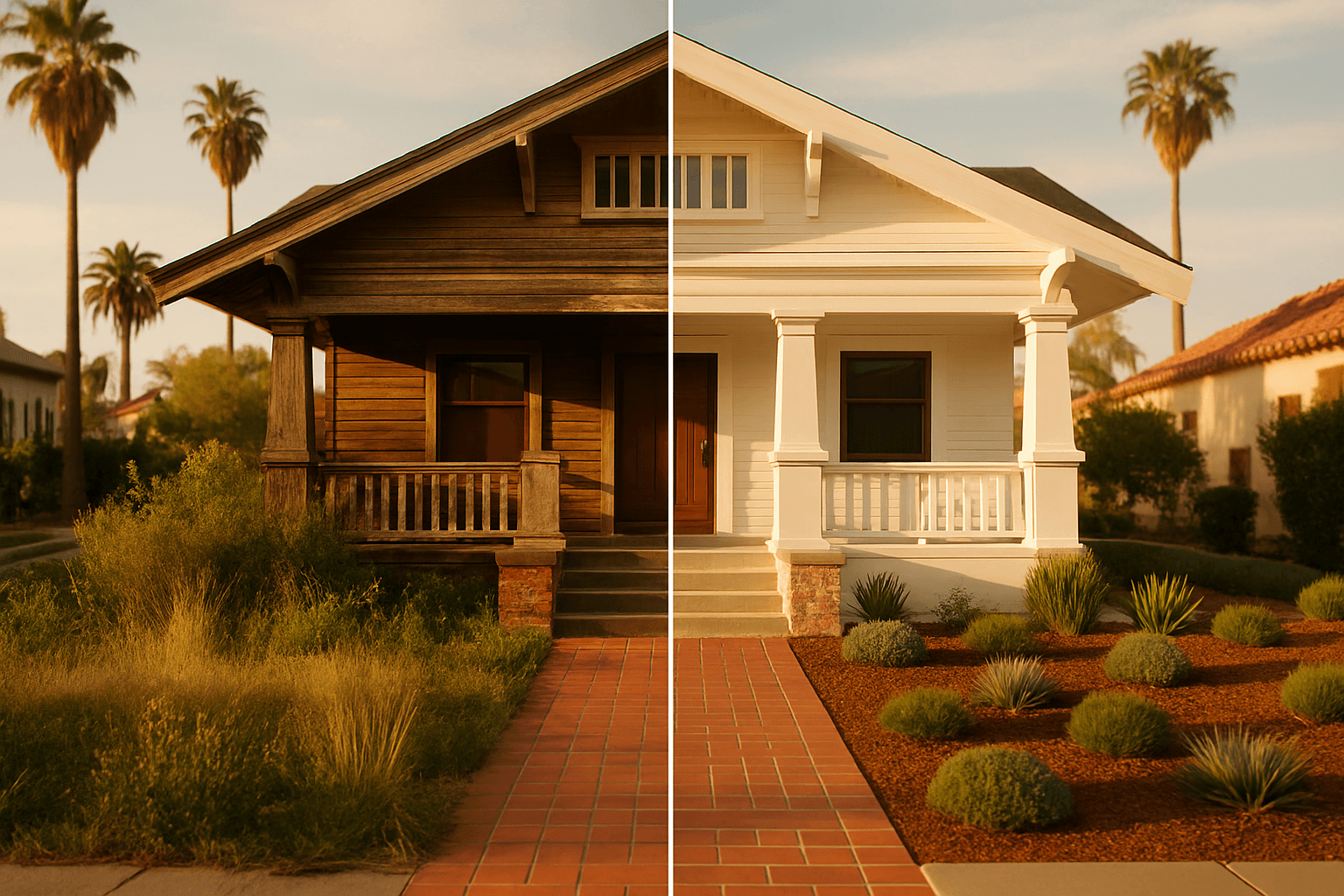
- Curb appeal and first impressions: Online photos are often a buyer's first "showing," so how a home photographs matters
- Lot size and usability: In LA, usable outdoor space is premium — especially post-2020
- Parking: Garage vs. street parking is a genuine value factor in most LA neighborhoods
- Recent permits and upgrades: Work done without permits can complicate a sale; documented improvements add credibility
Some of these you can influence before you list. Some you can't. But knowing where you stand helps you make smarter decisions about where to invest your time and energy before putting your home on the market.
When Pricing Gets More Complicated
There are situations where determining value becomes especially layered — and where having an experienced professional matters even more.
If the property is part of a probate or trust sale, there are additional considerations around court oversight, timelines, and how the property is presented and priced. I hold certifications in both Probate & Trust Real Estate and Short Sales & Foreclosures, and I regularly help families navigating these situations across LA County and beyond.
If you're facing financial hardship or the home has deferred maintenance, pricing strategy looks different than a traditional sale. It doesn't mean the home can't sell — it means the approach needs to be thoughtful and realistic.
The Right Starting Point
If you're curious about what your home is worth — whether you're ready to sell tomorrow or just thinking ahead — the most valuable thing you can do is have a conversation with someone who actually knows your market.
Not an algorithm. Not a national website that's never seen your backyard. A real person who can look at your home, understand its story, and give you an honest, data-backed number you can actually plan around.
That's exactly what I do — and I'd love to do it for you.
Visit homenest.house to get started, or call me directly at 323-472-7059. Whether you're in Glendale, Downey, Pomona, Long Beach, or anywhere across Southern California, I'm here to give you clarity — not just a number.
Suzanna Saharyan | Realtor, CENTURY 21 Realty Masters | Certified in Short Sales & Foreclosures, Probate & Trust Real Estate
Have a question about your home?
Suzanna Saharyan and the HomeNest team help homeowners across Southern California make confident moves. Get a free home value estimate or talk to a real human — no spam, no pressure.